

From Sacrifice Zones to Cultivation Grounds
Multispecies Ontology and the Curatorial Practice of Mutual Nurturance
Guely Morató Loredo
JUST PRACTICES: Artistic Research, Curating, and Climate Justice
From Sacrifice Zones to Cultivation Grounds
Listen to a conversation around the ideas developed in this essay
JUST PRACTICES: Artistic Research, Curating, and Climate Justice precisely maps the backbone of my investigation and practice.
This doctoral programme provides the exact methodological framework I need to formalize years of fieldwork across Bolivia, Chile, and Argentina. These three pillars converge through Yanak Uywaña (mutual nurturance), an Andean ontology I actively employ to foster community and reimagine technology-territory relations. The Netherlands offers a uniquely critical ecosystem: a society at the forefront of energy-transition debates, with robust institutional support for artistic research, a curatorial culture attuned to post-colonial critique, and active engagement with technodiversity discourses. The University of Amsterdam, alongside its institutional partners, provides the ideal infrastructure to transpose this practice into a context shaped by global extractive supply chains, testing how care-centered methodologies can generate new artistic experiences. This PhD is the essential space where my long-term research matures into rigorous, translocal climate justice praxis.
Statement
My practice operates at the intersection of artistic research, curatorial methodology, and territorial fieldwork. I develop situated forms of knowledge through listening, relational epistemologies, and collective processes.
Working across the Andean-Amazonian region and international institutional frameworks, I examine how extractivism is sustained not only through material infrastructures but through ontological systems that define value, perception, and relations between human and more-than-human worlds.
Through Sonandes, I have established a research infrastructure where curating functions as a practice of mutual nurturance (yanak uywaña), shifting from presentation toward cultivation.
My projects function as epistemic devices, producing knowledge through material transformation, duration, and participation. My current research focuses on technodiversity as a critical and practical horizon.
Sonandes: Germinal Ground
I founded Sonandes as a space for collective learning and thought: an artistic research infrastructure developing long-term, situated methodologies at the intersection of listening, territory, and artistic practice. Its foundation is international and interspecies cooperation, operating across Latin America and global institutional frameworks as a space for epistemic exchange.
The work is grounded in field research developed with communities, ecosystems, and more-than-human entities. From that foundation, Sonandes hosts the only Sound Art Biennial in Latin America, the Puertos creative residency programme, long-term research projects, exhibitions specialised in sound and listening, laboratories, and publications.
Its structure responds to a logic of nurturance rather than event production: each programme feeds the others, generating an ecosystem of knowledge that grows alongside the communities and territories that inhabit it.
From Sacrifice Zones to Cultivation Grounds: Multispecies Ontology and the Curatorial Practice of Mutual Nurturance.
Abstract
A doctoral research proposal situated at the intersection of curatorial practice, multispecies ontology, and decolonial epistemology. The research emerges from long-term fieldwork in the Lithium Triangle (Argentina, Bolivia, Chile) and from a trilogy of artistic projects: Wak’a, Triangle of Sacrifice, and Rare Earths. From this corpus, it mobilizes yanak uywaña, or the mutual nurturance of the arts, as systematized by Elvira Espejo Ayca (2022) from Andean Indigenous knowledge, as both a curatorial methodology and an ontological proposition.
The article argues that yanak uywaña operates as a concrete relational technology governing mutual care among humans, non-human beings, territories, materials, and infrastructures. In dialogue with Eduardo Viveiros de Castro’s multinaturalism (2004), Yuk Hui’s cosmotechnics and technodiversity (2016), Jason Moore’s Capitalocene (2015), and Ann-Sophie Lehmann’s theory of material meaning (2012), the research proposes an ecology of the senses as both an artistic and methodological framework that exceeds Western ocularcentrism.
The methodological structure sustained presence in the field, multispecies collective creation, and emergent curating, is articulated through a specific implementation in the Netherlands, where the doctoral research will be conducted.
Read the full essay
1. Introduction
The central problem driving this research is the contradiction between two temporal logics. The logic of the Capitalocene understands time as compressible, matter as extractable, and communities as disposable sacrifice zones. In contrast, the logic of yanak uywaña conceives time as relational and circular, matter as a living subject, and community as a network extending beyond the human toward multispecies relations of mutual care.
This tension is inscribed in the bodies of communities living in salt flats desiccated by lithium brine extraction, in the sacred water sources of Andean wak’as diverted by mining operations, and in the computational infrastructures of the Global North whose rare-earth components are assembled from ecologically sacrificed territories in the Global South, passing through manufacturing chains in Asia.
This research approaches these contradictions from within, as an inhabiting observer. The methodology of inhabited knowledge entails relocating practice and ontology into the territory under study, forming long-term relationships with multispecies communities, and producing artistic, curatorial, and theoretical knowledge from within those relations.
This text articulates the theoretical framework, methodological structure, and context of implementation of a doctoral inquiry that seeks to move—following the trajectory enacted by the trilogy of works—from documenting devastation toward cultivating the possible.
2. Theoretical Framework
2.1 The Critique of Visuality and the Ecology of the Senses
Western modernity has organized knowledge through vision. From the cultivated contemplation of Greek philosophy, through Cartesian perspectivism and the Enlightenment equation of vision and reason, to the contemporary dominance of the screen as the paradigmatic interface of knowledge production, ocularcentrism has functioned as an epistemological regime that systematically devalues non-visual modes of apprehending the world (Jay, 1994).
This hierarchy is not only aesthetic but also colonial. It has marginalized the sensory epistemologies of cultures that prioritize sound, touch, smell, and kinesthesia—precisely those senses through which Andean-Amazonian communities organize their most sophisticated forms of knowledge transmission and territorial relation.
The anthropology of the senses, as developed by David Howes (2005) and Constance Classen (1993), among others, proposes an ecology of the senses in which all sensory modalities are recognized as equally valid and culturally specific pathways to knowledge. Within this ecology, the image emerges as a synesthetic phenomenon woven through the interplay of all senses. What we hear, touch, taste, and smell participates equally in the construction of the image—a proposition I develop in my essay Sonic Ecology and Multispecies Pacts: Sound as Collective Practice in the Andean-Amazonian Worldview (2025).
Oral tradition and weaving, dominant inscription technologies in Andean cultures, function as alternative and multidimensional modes of knowledge storage, encoding history, cosmology, and identity through haptic and acoustic registers (Ochoa Gautier, 2014).
This critique of visuality directly informs the artistic practice extended in this research. The three works comprising the doctoral trilogy (Wak’a, Triangle of Sacrifice, and Rare Earths) operate through material and acoustic logics that exceed the visual. Their force resides in what is felt: sub-bass frequencies resonating in the chest, the smell of salt and copper, the weight of matter dissolving in real time.
In these works, the image is the outcome of an ecology of the senses, produced through the interaction of all perceptual modes and apprehensible only by a body equally distributed in its capacity to sense. The specific material choices of each work—ambisonics, corroding metals, edible Altiplano ingredients—function as what Lehmann (2012) describes as material attributions and interactions: they carry the temporal, chemical, and political signatures of the territories from which they emerge and render those signatures perceptible across the sensorium.
2.2 Yanak Uywaña: Mutual Nurturance as Ontological Proposition and Living Methodology
Yanak uywaña, translated as mutual nurturance, is a concept systematized by the artist and thinker Elvira Espejo Ayca (2022) from the ancestral epistemology of Aymara-speaking communities in the Bolivian Andes. It constitutes inhabitable cultural memory and embodied praxis: a set of relational practices governing mutual obligations among all forms of life and matter.
Scholars such as Zoe Todd (2016) and Kim TallBear (2017) have cautioned that Western academic enthusiasm for Indigenous ontologies can reproduce extractivist structures when these ontologies are appropriated as theoretical resources without reciprocity. This research positions itself from within these cosmologies as lived practice, distinguishing its approach from theoretical instrumentalization.
Espejo Ayca (2022) maps the architecture of uywaña across interconnected domains. Uywa uywaña designates the mutual nurturance of animals: the relationship between a shepherd and their llamas operates through reciprocal care, in which both sustain one another’s continuity. Ali uywaña extends this logic to plants: seeds are subjects nurtured across generations through selection, ceremony, and polyculture. Amta yaracch uywaña names the mutual nurturance of thought and feeling: ideas are co-produced through the magnetic field generated by encounters between bodies, instruments, and territories.
Most relevant to this research is yanak uywaña proper: the mutual nurturance of objects and goods, extending care into the technological and material domain. A textile, for example, is a living subject that requires care—protected from excessive sunlight, repaired, and respected as an entity that also cares in return.
This proposition—that tools, instruments, and infrastructures are subjects entering relations of mutual obligation with their makers and users—constitutes a radical departure from the Western hylomorphic model, in which matter is passive and form is imposed by an active mind (Ingold, 2013; Lehmann, 2012).
Yanak uywaña asserts that caring for a loom is ontologically equivalent to caring for a mountain: both are subjects of nurturance and participants in the magnetic field of collective creation.
2.3 Multinaturalism, Multispecies Community, and the Critique of Accelerationism
Eduardo Viveiros de Castro’s concept of multinaturalism (2004) provides the ontological foundation for this research’s understanding of community. Western modernity assumes a single shared nature inhabited by multiple cultures (multiculturalism). Amerindian perspectivism inverts this proposition: it posits a single shared mode of experiencing the world as a person, inhabited by a multiplicity of natures constituted through the body. What differentiates a jaguar from a human are their respective bodies, with their own affects, inclinations, and capacities. Each body constitutes a different world, inhabited from a singular perspectival position.
This multinaturalist ontology fundamentally reconfigures the concept of community. Within this framework, community is a multispecies, multinatural network of perspectives, each with its own temporality. The community of the Salar de Uyuni includes flamingos, brine copepods, lithium-saturated waters, wind, ancestral salt harvesters, and migratory birds: all of them inhabit distinct yet relational natures that together constitute the place. This understanding of community as a multinatural organism activates obligations of care across species and temporalities, and operates as a direct critique of accelerationism in all its variants.
Both right-wing accelerationism, as developed by Nick Land (2011), and left-wing accelerationism, as articulated by Srnicek and Williams (2015), share a structural commitment to the compression of time as value and to speed as an emancipatory force. The temporality of a mountain, however, is irreducible to this logic. The time of lithium crystallization is equally irreducible. Yanak uywaña operates from the premise that living well requires inhabiting the temporalities of matter, recognizing them as equally real and equally binding. This constitutes a rigorous ontological position, distinct from any romanticism of slowness.
Jason Moore’s concept of the Capitalocene (2015) is preferred here over that of the Anthropocene because it names a political-economic cause rather than distributing responsibility at the level of the species. The ecological crisis is the product of the specific logic of the capitalist organization of the web of life: its systematic construction of nature as “cheap” and of communities as sacrifice zones in service of accumulation. The Capitalocene names the historical conjunction of colonial extraction, industrial technology, and financial speculation that has organized the territories this research inhabits. Yanak uywaña, as a curatorial methodology, operates as a counter-logic to the Capitalocene: it insists on the non-cheapness of all matter, all life, and all temporality.
2.4 Cosmotechnics, Technodiversity, and the Question of Infrastructure
Yuk Hui’s concept of cosmotechnics (2016) maintains that every technology expresses a specific cosmological order: the technical object always embodies a particular understanding of the relationship between humans, nature, and the cosmos. Modern Western technology, premised on the Cartesian separation between subject and object, has globalized a monotecnics: a single technological regime that subordinates all other technical traditions to the logic of optimization, efficiency, and control. Against this globalizing tendency, Hui (2016) proposes technodiversity—that is, the proliferation of cosmologically distinct technical traditions—as a philosophical and political necessity for navigating the ecological crisis.
Yanak uywaña, as developed in this research, operates as a cosmotechnics in Hui’s sense. It embodies a specific cosmological order in which tools, materials, and infrastructures are subjects of mutual care. When Espejo Ayca (2022) describes the sami qamani (specialist in the mutual nurturance of natural dyes) or the sawu qamani (specialist in the mutual nurturance of the loom), she is describing technical roles organized through a cosmological order in which matter is sentient and reciprocity is the governing logic of production. Technodiversity, in this sense, implies a different understanding of the ends that technology ought to serve, and that difference carries ontological consequences that exceed the mere choice of means.
Its relevance for addressing mining infrastructure within this research is direct. The drip systems in Triangle of Sacrifice, calibrated to represent water consumption per ton of lithium sold, function as technical operators that enact counter-cosmotechnics. They render visible the temporality and materiality concealed within the supply chain by materializing the violence of technocolonialism through the logic of self-destruction. This is cosmotechnics as an artistic methodology: mobilizing the material properties of matter—its corrosivity, its temporality, its weight—to articulate what visual representation alone leaves unaccounted for.
3. The Trilogy of Extractivism: Materiality, Meaning, and Complicity
3.1 Wak’a: Sacred Matter and the Sonic Dimension of Neo-Extractivism
Wak’a (2020–ongoing) is a long-term field research project investigating the spiritual, sonic, and political dimensions of extractivism across Bolivia, Chile, and Argentina. Wak’as are sacred sites in Andean cosmology: mountains, springs, stones, and celestial bodies understood as living entities endowed with agency, memory, and obligations toward the human communities that care for them.
The project takes as its point of departure the animism of the Inca world. The arrival of colonizers activates evangelization through the Extirpation of Idolatries; this ontological shift reconfigures sacred beings as resources. A third movement amplifies the liturgical narratives that technology now assumes, and the sacred position it occupies within the contemporary imaginary and in the deployment of infrastructures and capital.
The methodology of Wak’a is explicitly acoustic and territorial. First-order ambisonic field recordings capture the sonic environments of extraction zones: the low frequencies of processing machinery, the absence of birdsong in contaminated wetlands, and the tonal qualities of bodies of water at different stages of salinization. These recordings constitute evidence of the sonic dimension of ecological violence and form the archive from which radio art pieces and immersive audiovisual essays are composed.
The methodology is grounded in the conviction that listening to extraction with the full body, and over sustained duration, produces knowledge that visual documentation cannot: the lived sensation of territorial loss and the multispecies temporality of place.
The material production of Wak’a operationalizes Lehmann’s (2012) insight that material meaning is a dynamic relation between interaction, attribution, and comparison. The selected materials (salt, water, mineral samples, ambisonics) carry the chemical and temporal signatures of extraction itself. The choice of audible matter over visual representation is deliberate: within Andean-Amazonian cosmology, the image is the result of an ecology of the senses, and it is through the acoustic ecology of the work that audiences are drawn into the multispecies temporality of the site.
3.2 Triangle of Sacrifice: Self-Destructive Infrastructure as Epistemological Device
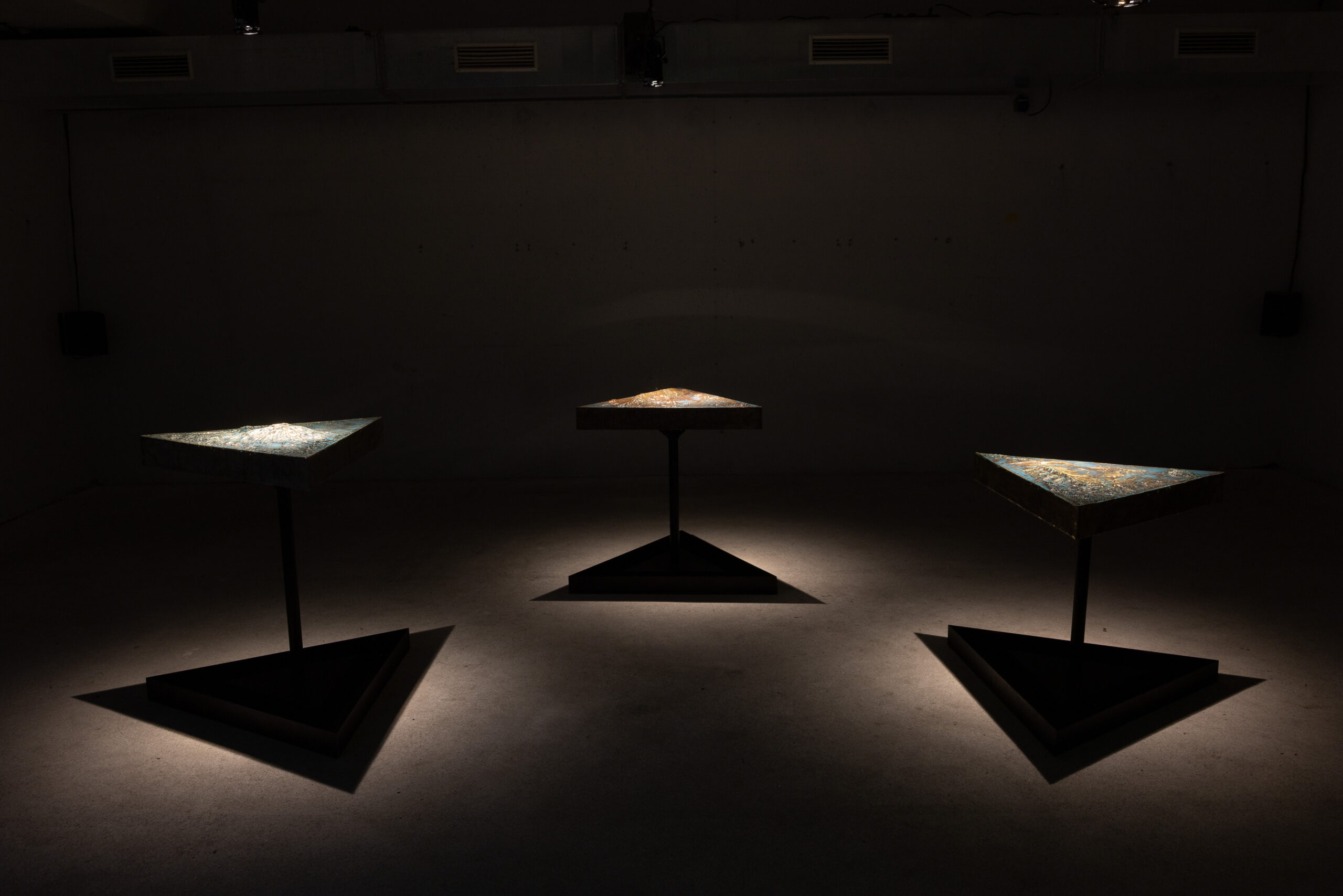
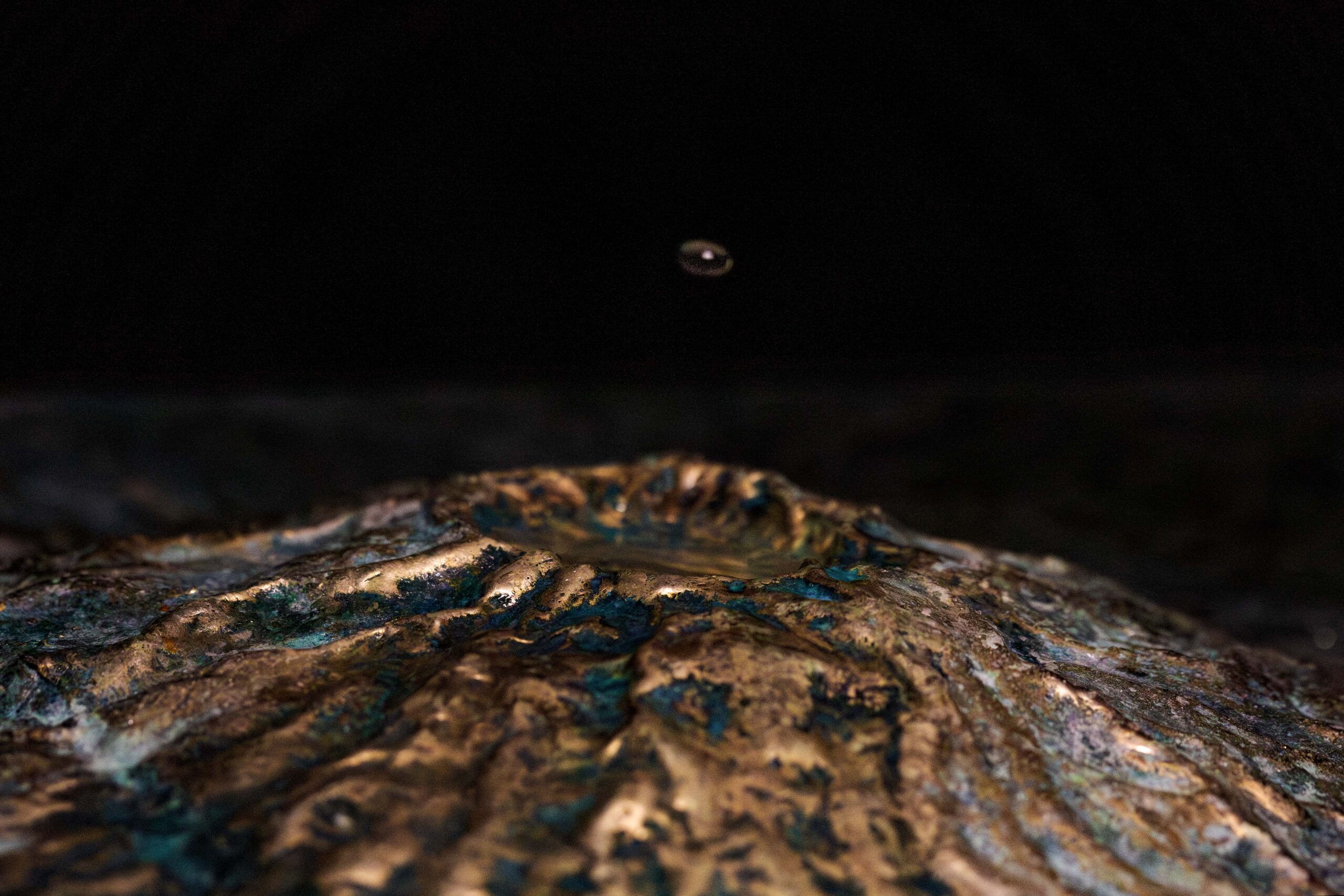
Triangle of Sacrifice (2023–ongoing) materializes the logic of technocolonialism through three self-destructive sculptures, each forged from a metal historically extracted from one of the three countries of the Lithium Triangle: bronze (Bolivia), silver (Argentina), and copper (Chile). Each sculpture is equipped with a saline drip system calibrated to represent the water consumption per ton of lithium sold on the global market. The sculptures corrode in real time over the duration of the exhibition, their material dissolving at the rate at which water is depleted in extraction, rendering visible a temporality that the supply chain deliberately conceals.
The work was awarded the CIFO × Ars Electronica Prize (2024) and subsequently exhibited at Ars Electronica (Linz, Austria) and at the Museum of the University of Antioquia (Medellín, Colombia), and is now part of the Ella Fontanals Cisneros Collection, currently one of the most significant collections of Latin American art. Its central epistemological operation activates what Viveiros de Castro (2004) terms a perspectival shift: the sculptures enact, in miniature, the logic of consumption of the territories from which they originate. The visitor discovers that their complicity pre-existed their entry into the space. The saline drip continues regardless of whether the exhibition space is occupied, enacting the indifference of extraction to human presence.
The selection of historically extracted metals constitutes a form of material memory. In Lehmann’s (2012) terms, bronze, silver, and copper carry the material signatures of Andean colonialism: they are the substances through which Europe financed its modernity at the cost of Andean life. As they are destroyed under the action of brine (a primary by-product of lithium extraction), this material memory is activated against the logic that produced it. The self-destruction is chemical, and precisely in being so, the work enacts the very technocolonial logic it critiques, rendering visible the relational cost that the supply chain renders invisible. Here, the viewer does not contemplate, but becomes a witness to slow destruction. The installation does not illustrate—it embodies.
3.3 Rare Earths: An Open Score for a Broken Supply Chain
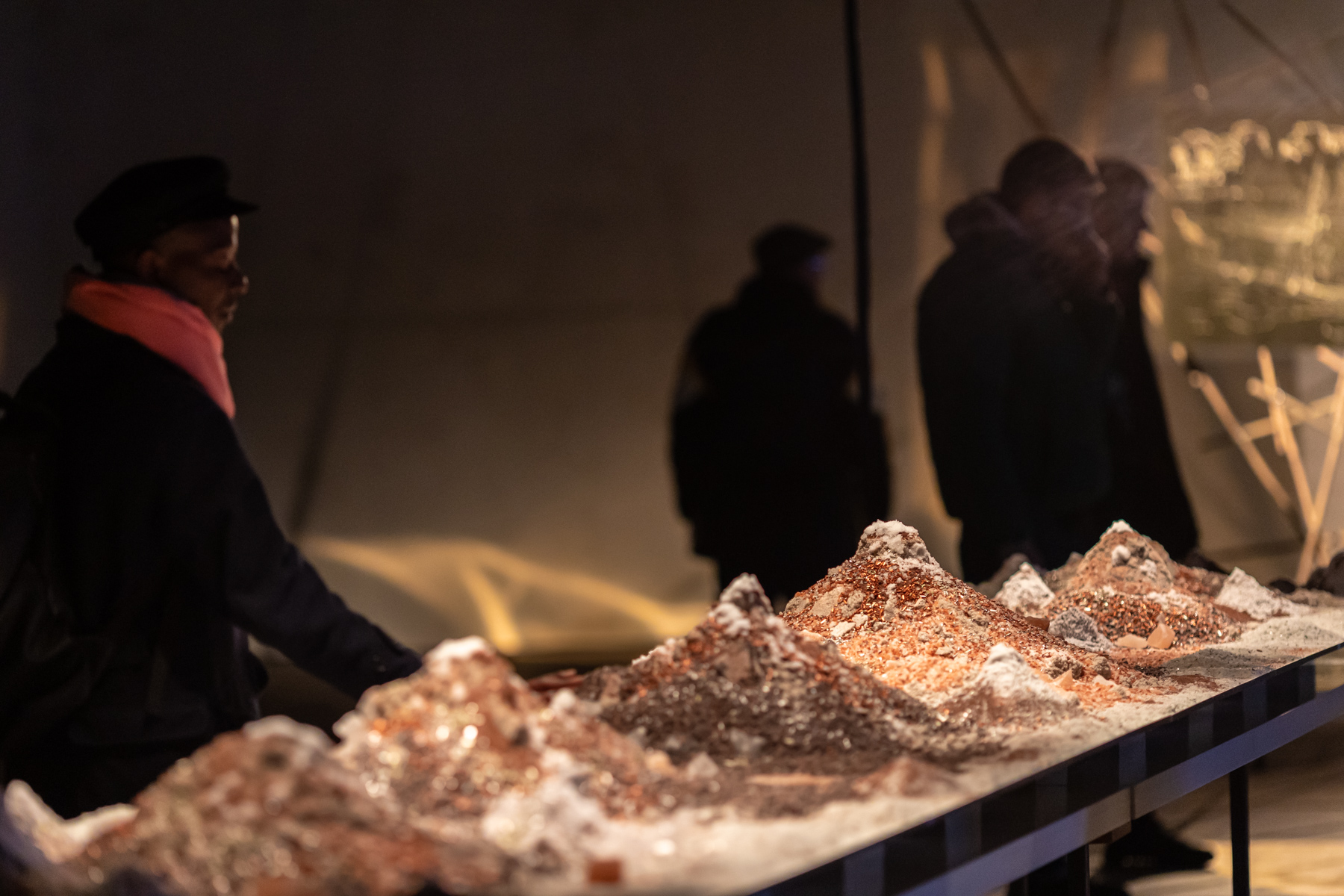
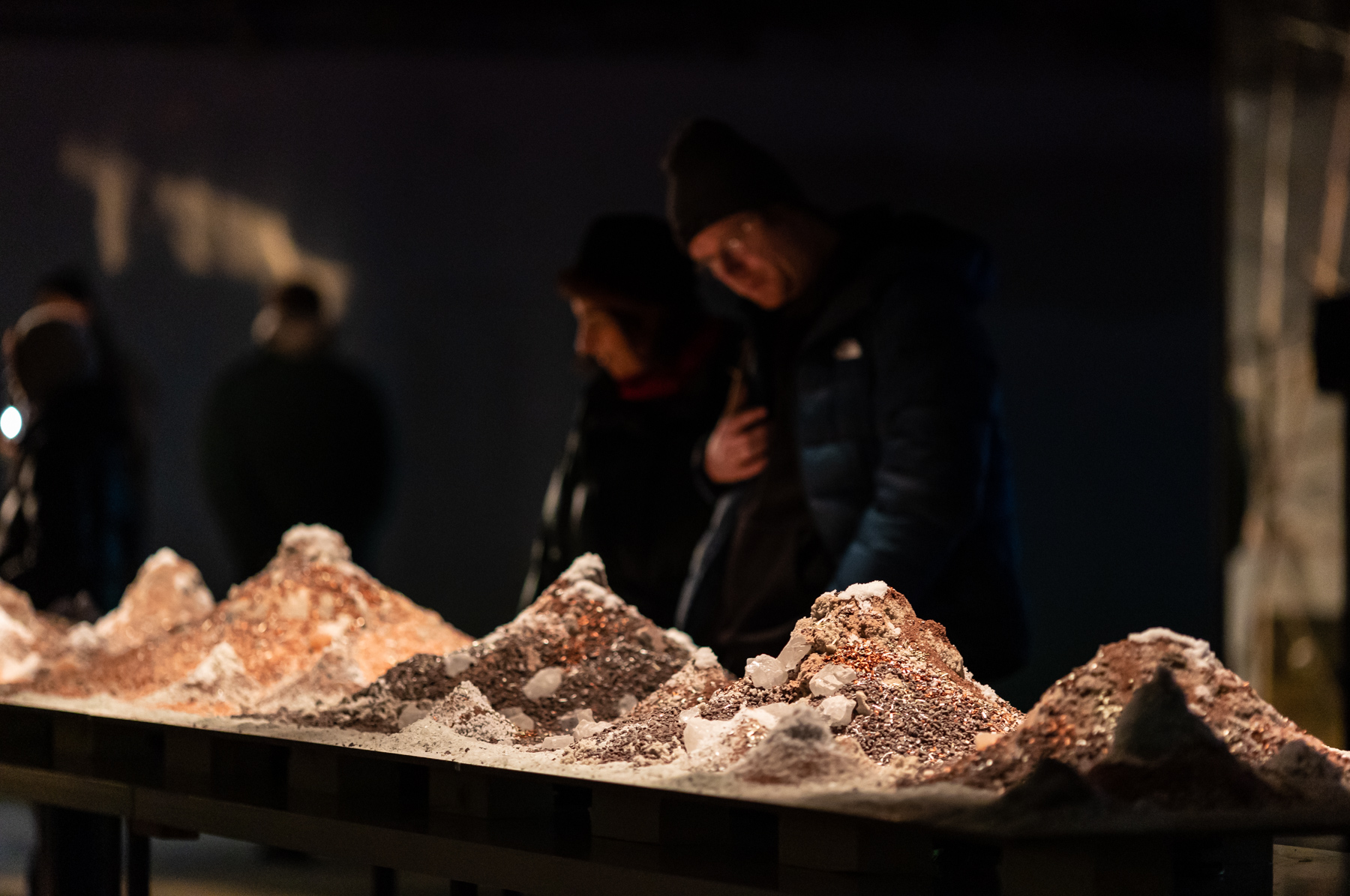
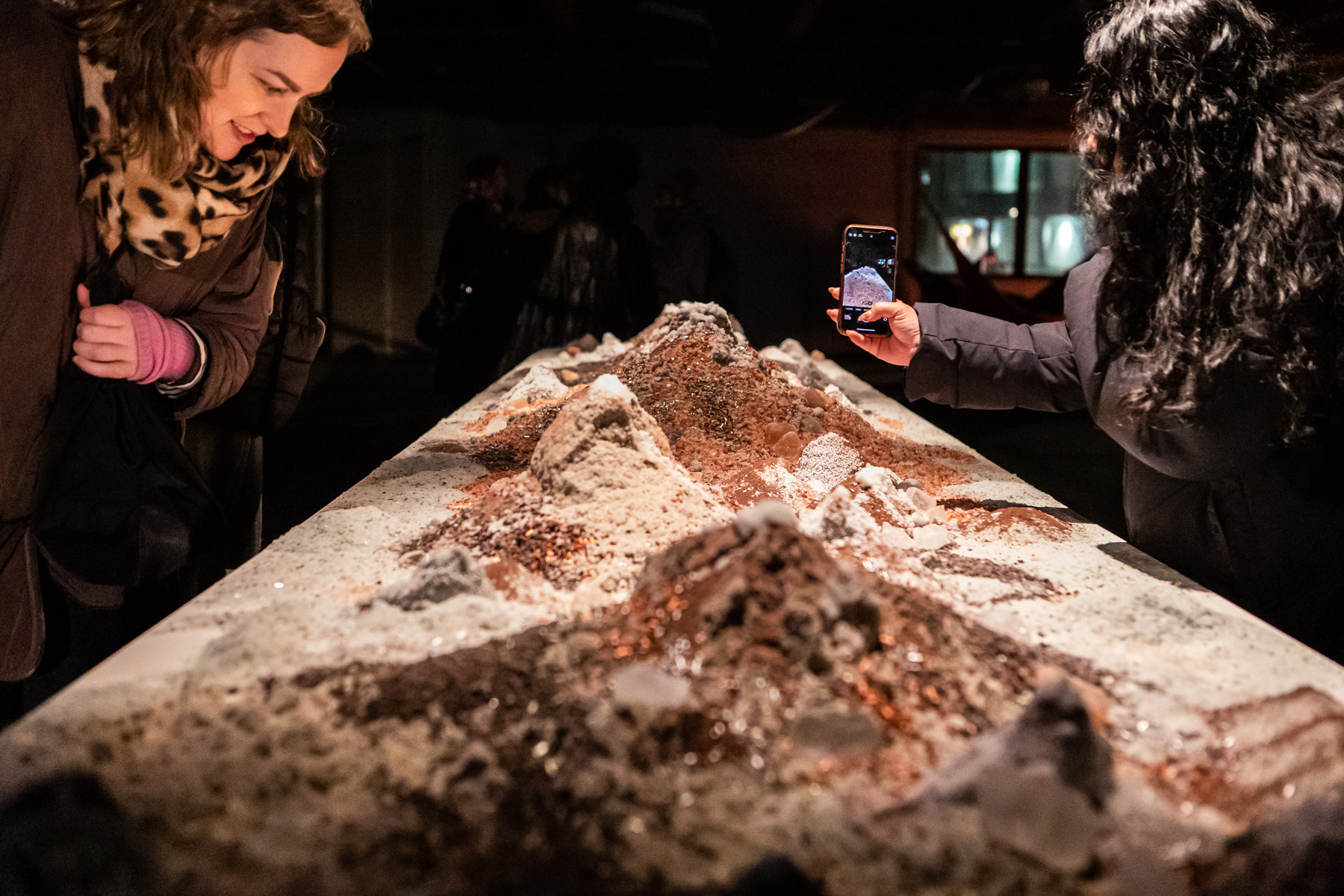
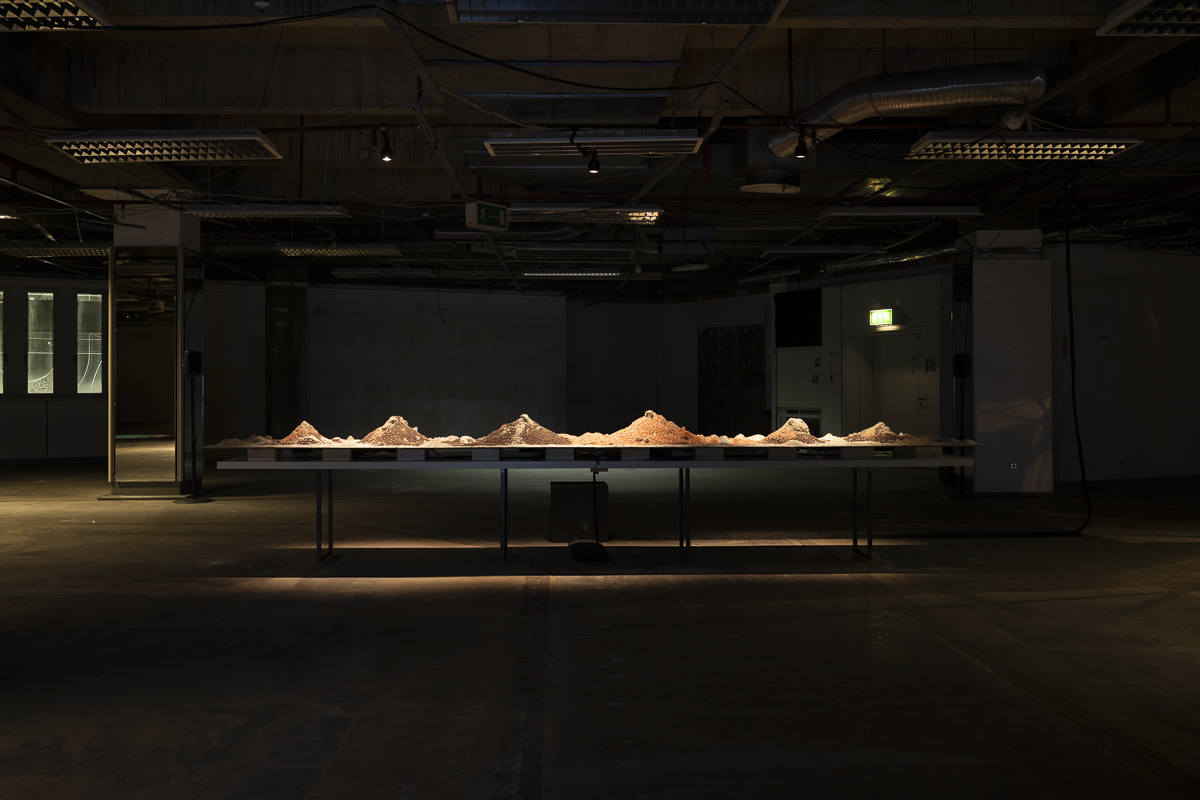
Rare Earths (2025–ongoing) constitutes the third movement of the trilogy and the work in which the shift from devastation to cultivation becomes most legible. It was first conceived as a multisensory performative dinner in its initial iteration (Delfina Foundation, London, 2025), and later as a multimedia installation in its second iteration (Transmediale Festival, Berlin, 2026). Participants confront their individual complicity in global extractive systems through the act of eating—or choosing not to eat—by taking a portion of the material body of the work.
The work functions as an open score adaptable to other ecosystems of ecological sacrifice. Within yanak uywaña, eating is a literal act of mutual nurturance: a ceremony in which human bodies enter into direct material relation with the territories from which food originates. The dinner activates an ecology of the senses—taste, smell, texture, sound, and the visual field of the table as a miniaturized landscape—as an epistemological method. Participants feel and ingest the Lithium Triangle, rather than learn about it. Presented at Transmediale 2026 (Berlin) as part of the program By the Mango Belt & Tamarind Road, the work opened a space for transregional solidarity between zones of extraction in the Americas and Africa.
4. Methodology: Inhabited Knowledge and Collective Authorship
4.1 Field Presence, Deterritorialization, and Long-Term Relation
The methodological foundation of this research is inhabited knowledge: the relocation of practice, body, and ontology into the territory under study over sustained periods of years. This mode of working differs from fieldwork in the anthropological sense of distanced participant observation. Rather, it constitutes a methodological deterritorialization in the sense proposed by Deleuze and Guattari (1987), followed by reterritorialization: knowledge is produced from within the new territory, and the practice is fundamentally transformed by what it encounters.
The relationships established through this sustained inhabitation are maintained over years, through multiple visits, participation in community events, and the reciprocal obligations that yanak uywaña entails. This sustained relational practice produces knowledge rather than reproducing an extractive logic: the research remains in the territory, and the community of inquiry—multispecies, multigenerational, and multimaterial—develops from within the continuity of the relationship.
Tim Ingold’s (2013) notion of correspondence knowledge as the alignment of the movements of the researcher with the movements of that which is studied, accurately describes this methodology.
4.2 Multispecies Collective Creation and Distributed Curatorial Authorship
The community that emerges from sustained presence in the field is explicitly multispecies. It includes human collaborators (artisans, scientists, miners, community organizers, artists), as well as the territories themselves: the salt flats whose brine chemistry shapes Triangle of Sacrifice, the mountain springs whose sonic environments constitute the archive of Wak’a, and the native plants whose nutritional properties structure the score of Rare Earths. These non-human participants are co-authors of the work: their properties, temporalities, and resistances determine what it is possible to produce.
Lehmann (2012) argues that materials are active agents in the production of meaning through their interactions, attributions, and comparisons. In this research, that agency is extended to territories, communities, and non-human beings, following the logic of yanak uywaña. The saline solution that destroys the sculpture, the quinoa that flavors the meal, the mountain whose destruction is registered as low-frequency sound: all are co-authors with equivalent ontological weight.
The curatorial practice that extends from this methodology follows the same logic. The biennials, exhibitions, and residency programs developed through Sonandes function as processes of collective intelligence in which the curatorial text emerges from the conflicts, intensities, and material relations generated through sustained communal encounter. This processual and emergent model corresponds to what Rogoff (2010) identifies as curatorial practice as an act of gathering that produces new publics, and to what Mörsch (2009) describes as transformative art education: modes of cultural production in which the institution becomes a site of collective knowledge production rather than authorized transmission.
5. Implementation in the Netherlands: Deterritorialization as Method
5.1 The Dutch Context: Complicity and Institutional Capacity
The decision to conduct this research in the Netherlands responds to a structural logic that extends beyond the institutional. The Netherlands occupies a central position within the global extractive economy: as a major node in the trade of raw materials, financial services, and technological manufacturing, the country is deeply embedded in the supply chains that connect the Lithium Triangle to the digital devices consumed in the Global North.
Dutch companies participate in the financing and distribution of rare earth minerals that constitute the material substrate of the digital baroque: the contemporary continuation of a logic of excess and ornamentation originating in the colonial period and sustained today through artificial intelligence, space missions, and large-scale data centers with high energy consumption.
At the same time, the Netherlands offers exceptional institutional and civic capacity for the type of research this project proposes. Its dense landscape of museums, cultural centers, neighborhood organizations, and transnational diasporic networks—with a particular presence of Surinamese, Indonesian, and Caribbean communities historically linked to Dutch colonial extraction—provides a fertile ground for the development of multispecies social choreographies: collective practices that experiment with alternative forms of community, temporality, and interspecies coexistence.
5.2 Reconfiguring Yanak Uywaña in the Dutch Territory
The first phase of the doctoral research entails a methodological deterritorialization: relocating the practice (the body, the tools, the relational methodology) into the Dutch territory and allowing the concept of yanak uywaña to be tested, extended, and transformed through encounters with new multispecies communities. This phase constitutes a rigorous inquiry into what forms of mutual nurturance emerge from a specific conjunction of bodies, histories, ecologies, and institutions, and operates in the inverse direction of simply transposing Andean concepts into a European context.
The research will unfold through four primary sites of engagement. Urban neighborhoods with significant Surinamese, Indonesian, and Caribbean populations offer spaces where the connections between colonial history and contemporary extractivism are most legible. Rural territories affected by intensive agriculture and gas extraction provide sites in which multispecies communities organized around soil health, water systems, and migratory birds offer grounds for the development of alternative practices of nurturance. Institutional spaces (museums, cultural centers, universities) will become sites for collective exhibitions and workshops structured by the logic of yanak uywaña. Transnational nodes will connect the Dutch research context with communities in the Lithium Triangle and with other ecological sacrifice zones in Asia and Africa through the open-score format of Rare Earths, enacting the multispecies solidarity that the research theorizes.
The methodological question guiding this implementation is the following: what does it mean to nurture a multispecies community in a context where ecological and colonial connections are visible, yet where the cultural memory of reciprocal obligation has been eroded by centuries of capitalist urbanization? The research hypothesizes that cultural institutions, when governed by the logic of yanak uywaña, can function as sites of uñachht’ayaña: making visible the relations of mutual dependence that already exist but have been rendered invisible by the dominant ontology. The museum becomes a field of forces in which multispecies communities practice forms of care that exceed the human and the national.
5.3 Toward Technodiversity: The Political Stakes of the Research
The ultimate ambition of this doctoral research, following Hui’s (2016) call for technodiversity, is to contribute to the development of alternative technological imaginaries through the generation of cultural, aesthetic, and ontological alternatives to monotecnics. Yanak uywaña, as a cosmotechnics, proposes that tools, materials, and infrastructures are subjects of care. This proposition, developed through years of artistic practice and now subjected to rigorous doctoral inquiry, holds the potential to articulate a new ontology of the technological—one in which innovation is evaluated according to its relational integrity, by the quality of mutual nurturance it enables among humans, non-human beings, territories, and temporalities.
This research argues that the future of technology must be plural: different communities, organized through different cosmological orders, must be able to develop technical traditions that express their own understanding of the relationship between humans, matter, and the cosmos. This aligns with Hui’s (2016) position as both a political and philosophical argument, distinct from any nostalgia for precolonial craftsmanship.
The research contributes to this project by demonstrating, through practice, that an alternative cosmotechnics constitutes a living methodology capable of generating new forms of community, temporality, and multispecies justice in the contemporary moment.
6. Conclusion: Walking Backwards into the Future
In Andean cosmology, the future lies behind, carried on the back, visible only through the past. Qhipa pacha—the time-space that is both behind and ahead—names the circularity of a temporality that turns rather than progresses. This research proposes inhabiting that circularity within the cultural institution as a rigorous methodological and ontological commitment to forms of mutual nurturance that the Capitalocene has rendered invisible and disposable.
From Sacrifice Zones to Cultivation Grounds names a movement that is simultaneously artistic, methodological, and political: from the documentation of devastation to the practice of possibility. The trilogy of works (Wak’a, Triangle of Sacrifice, Rare Earths) traces this movement across a decade of sustained fieldwork and collective creation. The doctoral research deepens and formalizes it by bringing the methodology of yanak uywaña into sustained engagement with the institutional, ecological, and social contexts of the Netherlands.
What can be learned from a sacrifice zone? Quinoa grows at the margins of the salt flats. Halophilic microorganisms thrive in brine that would kill other forms of life. Flamingos nest in the shallow waters that remain. Life—multispecies, multinatural, multitemporal—persists and adapts through forms of mutual nurturance that no extractive logic can fully extinguish. This research proposes to learn from that persistence and to bring what it learns into cultural institutions that bear both the responsibility and the possibility of imagining otherwise.
References
Bar-On, Y. M., Phillips, R., & Milo, R. (2018). The biomass distribution on Earth. Proceedings of the National Academy of Sciences, 115(25), 6506–6511. https://doi.org/10.1073/pnas.1711842115
Classen, C. (1993). Worlds of sense: Exploring the senses in history and across cultures. Routledge.
Deleuze, G., & Guattari, F. (1987). A thousand plateaus: Capitalism and schizophrenia (B. Massumi, Trans.). University of Minnesota Press. (Obra original publicada en 1980)
Espejo Ayca, E. (2022). Yanak uywaña: La crianza mutua de las artes. PCP – Programa Cultura Política.
Harrison, R., & Sterling, C. (Eds.). (2020). Deterritorializing the future: Heritage in, of and after the Anthropocene. Open Humanities Press.
Howes, D. (Ed.). (2005). Empire of the senses: The sensual culture reader. Berg.
Hui, Y. (2016). The question concerning technology in China: An essay in cosmotechnics. Urbanomic.
Hui, Y. (2020). Machine and ecology. Angelaki: Journal of the Theoretical Humanities, 25(4), 54–66. https://doi.org/10.1080/0969725X.2020.1827090
Hui, Y. (2021). Art and cosmotechnics. e-flux/University of Minnesota Press.
Ingold, T. (2013). Making: Anthropology, archaeology, art and architecture. Routledge.
Jay, M. (1994). Downcast eyes: The denigration of vision in twentieth-century French thought. University of California Press.
Land, N. (2011). Fanged noumena: Collected writings 1987–2007 (R. Mackay & R. Brassier, Eds.). Urbanomic/Sequence Press.
Le Breton, D. (2017). Sensing the world: An anthropology of the senses (C. Ruschiensky, Trans.). Bloomsbury Academic.
Lehmann, A.-S. (2012). How materials make meaning. Nederlands Kunsthistorisch Jaarboek / Netherlands Yearbook for History of Art, 62, 6–27. https://doi.org/10.1163/22145966-06201002
Moore, J. W. (2015). Capitalism in the web of life: Ecology and the accumulation of capital. Verso.
Morató Loredo, G. (2025a). Sonic ecology and multispecies pacts: Sound as collective practice in the Andean-Amazonian worldview. En Sound Chronicles. Dirección General de Creatividad Contemporánea, Ministerio de Cultura de Italia & MPDS Audio Archive.
Morató Loredo, G. (2025b). Wak’a: Neo-extractivism, sacredness and deep listening. En Ecosystems of tomorrow. Prince Claus Fund & Goethe-Institut.
Morató Loredo, G. (2025c). Cosmotechnics beyond the capitalocene. En H. Andrews & A. Hawcroft (Eds.), Why technology needs artists: 40 international perspectives. British Council.
Mörsch, C. (2009). At a crossroads of four discourses. En C. Mörsch (Ed.), Documenta 12 education II (pp. 9–31). Diaphanes.
Ochoa Gautier, A. M. (2014). Aurality: Listening and knowledge in nineteenth-century Colombia. Duke University Press.
Rogoff, I. (2010). Turning. En P. O’Neill & M. Wilson (Eds.), Curating and the educational turn (pp. 32–46). Open Editions/de Appel.
Srnicek, N., & Williams, A. (2015). Inventing the future: Postcapitalism and a world without work. Verso.
Sterling, C. (2021). Becoming hauntologists. Heritage & Society, 14(1), 67–86. https://doi.org/10.1080/2159032X.2021.2016049
TallBear, K. (2017). Beyond the life/not life binary. En J. Radin & E. Kowal (Eds.), Cryopolitics: Frozen life in a melting world (pp. 179–202). MIT Press.
Todd, Z. (2016). An indigenous feminist’s take on the ontological turn. Journal of Historical Sociology, 29(1), 4–22. https://doi.org/10.1111/johs.12124
Viveiros de Castro, E. (2004). Perspectivism and multinaturalism in indigenous America. En A. Surrallés & P. García Hierro (Eds.), The land within (pp. 36–74). IWGIA.
Viveiros de Castro, E. (2014). Cannibal metaphysics: For a post-structural anthropology (P. Skafish, Trans.). Univocal. (Obra original publicada en 2009)
In the Andes,
the future, like a child,
is carried on the back
The Netherlands and Just Practice
Offers a structurally significant site for this research: a major node in global extractive supply chains and an institutional landscape with exceptional capacity for experimenting with new social choreographies. The methodology enacts a rigorous deterritorialization of yanak uywaña (mutual nurturance of the arts), testing it in sustained encounter with local multispecies communities across four sites: urban neighborhoods shaped by colonial diasporas; rural territories under agroindustrial pressure; cultural institutions; and transnational nodes connecting to the Lithium Triangle. The guiding question is: what forms of nurturance emerge when the museum commits to cultivating bonds? The political horizon is technodiversity (Yuk Hui): demonstrating, through curatorial practice, that technical infrastructures can become subjects of care, and that innovation can be evaluated by its relational integrity and its capacity to enable multispecies justice across species, territories, and temporalities.
Trilogy Framework
From Ontological Paradigms to Everyday Complicity
This trilogy articulates a research trajectory that moves from the analysis of extractive paradigms to their embodied, material, and everyday manifestations.
Together, the three researchs constitute a methodological progression: from ontology to materiality, from witnessing to complicity. The trilogy constructs conditions in which extractivism can be perceived, inhabited, and critically reconfigured. In this sense, the projects function as epistemic devices through which alternative modes of relation, grounded in listening, reciprocity, and technodiversity, begin to emerge.
Wak’a
Neo-extractivism, Sacredness & Listening
Establishes the epistemic ground by examining how regimes of belief organize the conditions of extraction. It identifies sacrality as a governing infrastructure that determines what can be taken, from whom, and under which terms. This first movement situates extractivism within a broader cosmological and political economy.
Triangle of Sacrifice
Infrastructures of Technocolonialism
Displaces this inquiry into the realm of material experience. Extraction is no longer analyzed as a paradigm but enacted as a process that unfolds through time, matter, and perception. The work produces knowledge through corrosion, duration, and the ethical condition of witnessing, where the subject becomes implicated in what is observed.
Rare Earths
Open Score for a Broken Chain
Extends this trajectory into the scale of everyday life. Here, extractivism is traced within the micro-gestures that sustain global supply chains, revealing complicity as a distributed and embodied condition. Participation becomes performative, collapsing distance between system and subject.
WAK’A: Neo-extractivism, Sacredness & Deep Listening
Ontological Paradigms and the Political Economy of the Sacred
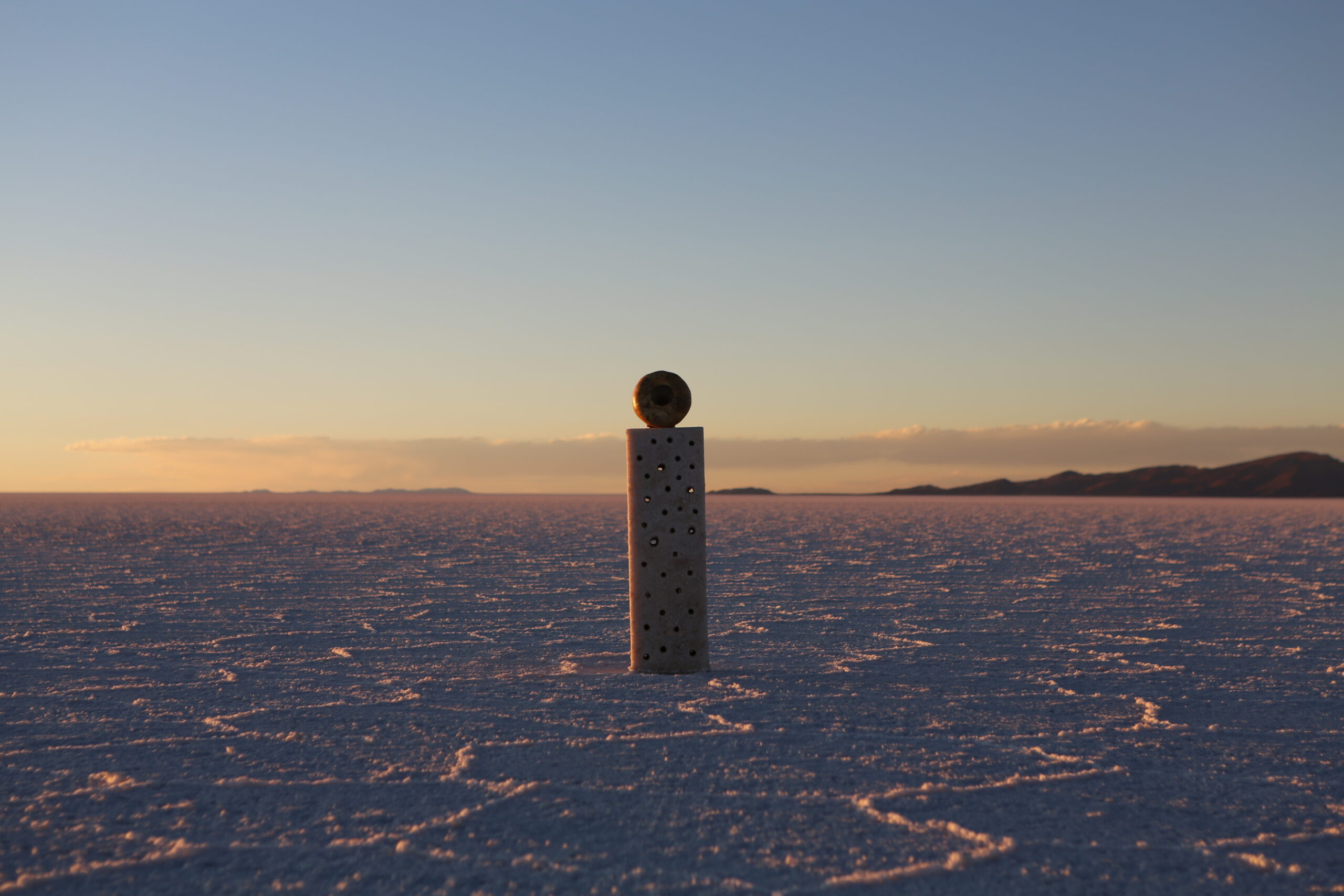
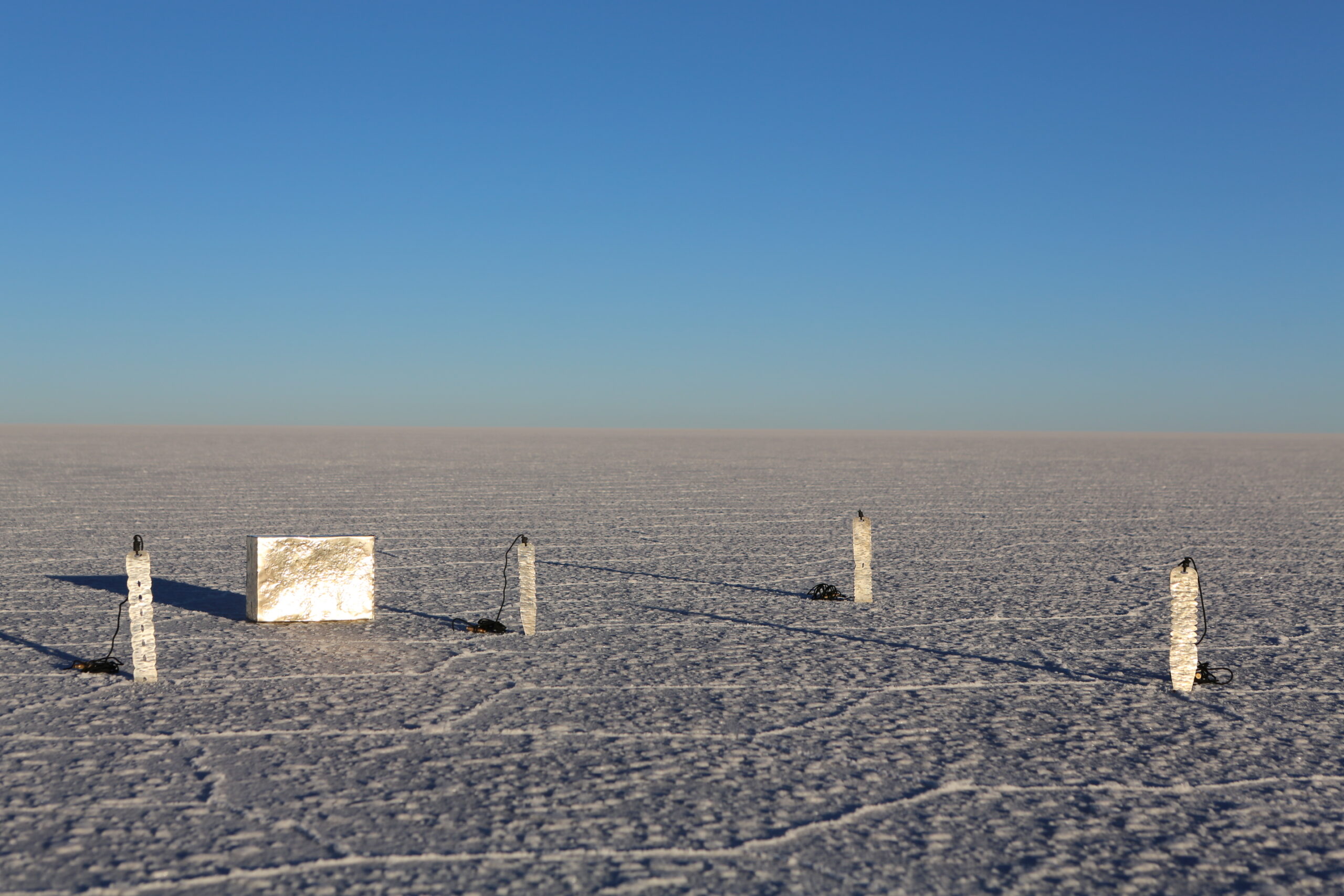
Wak’a traces three coexisting belief structures that organize power and economic value across time. Andean animism regulates territory through reciprocal obligations between communities and ecosystems, where extraction remains bound to relational accountability. Evangelization fractures this condition, displacing the sacred and redefining land as inert, ownable matter. In doing so, it establishes the ontological ground upon which extractivism operates.
Contemporary technology extends this transformation as a new liturgical regime. It mobilizes faith in progress, consolidates authority through opacity, and normalizes sacrifice zones as conditions of development. Its force is not only infrastructural but symbolic, sustained through belief systems that remain largely unquestioned.
Within this continuum, sacrality emerges as a governing infrastructure rather than a residual spiritual category. What a society holds as sacred delineates the limits of extraction, assigning value, legitimacy, and disposability. Wak’a reveals that extractivism does not begin with the act of extraction itself, but with the prior reconfiguration of what is allowed to be taken, and what must remain untouchable.


Technology promises
immortality,
no longer in heaven
but on Mars.
TRIANGLE OF SACRIFICE: Infrastructures of Technocolonialism
Epistemic Materiality and the Implicated Witness
Triangle of Sacrifice unfolds extraction as a material and epistemic process. Through calibrated saline dripping, the sculptures corrode in real time, registering the environmental cost of lithium mining as a gradual transformation of matter. Knowledge takes form through duration, exposure, and the visible erosion of structure.
The temporality of the work is irreversible. Its outcome is known, yet its unfolding demands sustained attention. This condition displaces the viewer toward a position of witnessing that carries ethical consequence. To witness is to become inscribed within the event, as in juridical testimony, where presence implies responsibility.
As the process advances, the installation recalibrates perception. Matter diminishes, sound thins, and space loses stability. The dense vibrational field of the Lithium Triangle slowly dissipates into wind, while light withdraws until the room is left in darkness. Visibility itself collapses alongside the object.
At its limit, the work becomes inaccessible. Entry is no longer possible; only the trace of the process remains. Corrosion, disappearance, and the persistence of wind mark the exhaustion of a sacrifice zone. What remains is not representation, but aftermath. Matter, having reached its threshold, produces silence as its final form of knowledge.


RARE EARTHS: Open Score for a Broken Chain
Supply Chains and Everyday Complicity
Rare Earths maps global supply chains through situated, repeatable actions that shift across territories and contexts. The chain does not break; it disperses. Its continuity depends on its fragmentation across scales, embedded within the ordinary rhythms of contemporary life.
The work attends to the micro-gestures that sustain extractivism. Eating, or refusing to eat, condenses planetary infrastructures into intimate bodily experience, where decision and consequence become inseparable. These minimal actions echo the distributed nature of global systems, where responsibility rarely appears as a singular act.
Participation unfolds as performance. The audience activates the same logic it is invited to examine, inhabiting the tension between awareness and implication. Meaning accumulates through repetition, variation, and the gradual recognition of one’s position within the chain.
As an open score, the work resists closure. It remains contingent, shaped by each iteration and its specific conditions. Listening operates here as an ethical practice, not only amplifying voices from territories under extraction, but reconfiguring the conditions under which those voices can be perceived. Within this framework, complicity is not an abstract condition but a lived, everyday relation.
Copper, gold, tin, lithium
An audio fragment from Rare Earths, an open score that mutates each time it inhabits a Sacrifice Zone.